
What to Look for When Choosing a Therapy Dog: Why Australian Labradoodles Are an Exceptional Choice

A therapy dog can change lives—bringing comfort to children in hospitals, companionship to seniors, emotional support to those navigating difficult seasons, and calm to individuals facing anxiety, trauma, or special needs. But not every dog is naturally suited for this important role.
Choosing the right therapy dog means looking far beyond a cute face or a popular breed—it means selecting a dog with the right temperament, trainability, and emotional intelligence.
If you’re considering a therapy dog, one breed consistently rises to the top of the list: the Australian Labradoodle.
Let’s explore what makes a great therapy dog—and why Australian Labradoodles are often considered one of the very best choices.
What Makes a Great Therapy Dog?
Not every dog is naturally wired for therapy work. A true therapy dog needs a special combination of temperament, confidence, and trainability.
Here are the top qualities to look for:
1. Calm, Steady Temperament
A therapy dog must remain composed in unpredictable environments—busy hospitals, classrooms, nursing homes, airports, or counseling offices.
Look for a dog that:
Recovers quickly from surprises
Isn’t easily startled by loud noises
Can relax in unfamiliar settings
Handles crowds and new experiences well
The best therapy dogs are emotionally steady—not overly reactive or easily overwhelmed.
2. Human-Focused Personality
Therapy work is all about connection.
A great therapy dog genuinely enjoys people—not just their owner, but strangers too. They should seek interaction, enjoy being touched, and naturally gravitate toward human companionship.
Signs to look for:
Makes eye contact
Enjoys cuddling
Seeks affection
Wants to stay near people
This is one reason Australian Labradoodles stand out—they were intentionally bred to be highly people-oriented.
3. Intelligence and Trainability
Therapy dogs need more than basic obedience. They must learn advanced manners, emotional regulation, and sometimes specialized tasks.
You want a dog that:
Learns quickly
Wants to please
Responds well to positive reinforcement
Can focus despite distractions
Australian Labradoodles are known for their exceptional intelligence, inherited from both the Poodle and Labrador Retriever—two famously trainable breeds.
4. Confidence Without Aggression
A good therapy dog should be curious and confident—not fearful or pushy.
Watch how a puppy responds to:
New sounds
New surfaces
New people
Gentle handling
A confident puppy investigates calmly rather than hiding or reacting defensively.
5. Emotional Sensitivity
This is the “magic” trait.
Some dogs naturally seem to feel what humans feel. They lean in when someone is sad. They stay close when someone is anxious. They instinctively offer comfort.
Many Australian Labradoodle owners describe this trait as almost uncanny—their dogs simply seem to “know.”
Why Australian Labradoodles Excel as Therapy Dogs

The Australian Labradoodle wasn’t created by accident.
Unlike many first-generation doodles, Australian Labradoodles were intentionally developed over generations with a focus on temperament, health, intelligence, and companionship.
That matters.
Here’s why they shine in therapy roles:
1. They Were Bred for Human Connection
Australian Labradoodles were developed specifically as companion dogs.
Their purpose was to work with humans—not independently.
That translates into dogs that:
Bond deeply
Love being included
Thrive on interaction
Read human emotions well
2. Their Temperament Is Predictable
Because responsible breeders carefully select for temperament generation after generation, well-bred Australian Labradoodles tend to have more predictable personalities.
That’s incredibly important when selecting a therapy prospect.
You want consistency—not guesswork.
3. Low-Shedding Coats Help More People
Many therapy environments—hospitals, schools, counseling centers—prefer low-shedding dogs.
Australian Labradoodles are beloved for their allergy-friendly coats, which can make them accessible to more people.
(Important note: no dog is completely hypoallergenic—but many families find ALDs easier to live with.)
4. They Come in Many Sizes
Need a small lap-sized comfort dog?
Or a larger dog for grounding and mobility support?
Australian Labradoodles come in:
Mini
Medium
Standard
That flexibility helps match the dog to the job.
5. They Love Having a Purpose
Many ALDs thrive when given “work.”
Whether that means:
visiting a hospital,
reading with children,
supporting a student at school,
or comforting someone during counseling,
They often genuinely enjoy the role.
How to Pick the Right Australian Labradoodle Puppy for Therapy Work

Choosing the right puppy matters just as much as choosing the right breed.
Here’s what to prioritize:
Work With an Ethical Breeder
Choose a breeder who:
focuses heavily on temperament
performs health testing
understands therapy placements
can honestly evaluate puppies
A good breeder can often identify which puppies have therapy potential.
Don’t Pick Based on Color
This is a common mistake.
The prettiest coat does not equal the best therapy candidate.
Temperament always comes first.
Always.
Ask About the Parents
A puppy’s parents tell you a lot.
Ask:
Are the parents calm?
Social?
Confident?
Therapy or service certified?
Temperament is highly heritable.
Look for the “Middle of the Pack” Puppy
For therapy work, avoid extremes.
Usually ideal: ✔ not the shyest ✔ not the boldest ✔ not the busiest
You often want the puppy that is curious, calm, affectionate, and adaptable.

Ask About Early Neurological Stimulation & Socialization
The best breeders expose puppies early to:
sounds
textures
people
gentle handling
problem solving
That foundation creates resilient dogs.
Final Thoughts
A therapy dog is more than a pet—they become a bridge between people and healing.
While many breeds can do therapy work, the Australian Labradoodle has earned its reputation for a reason: intelligence, empathy, trainability, adaptability, and an extraordinary love for people.
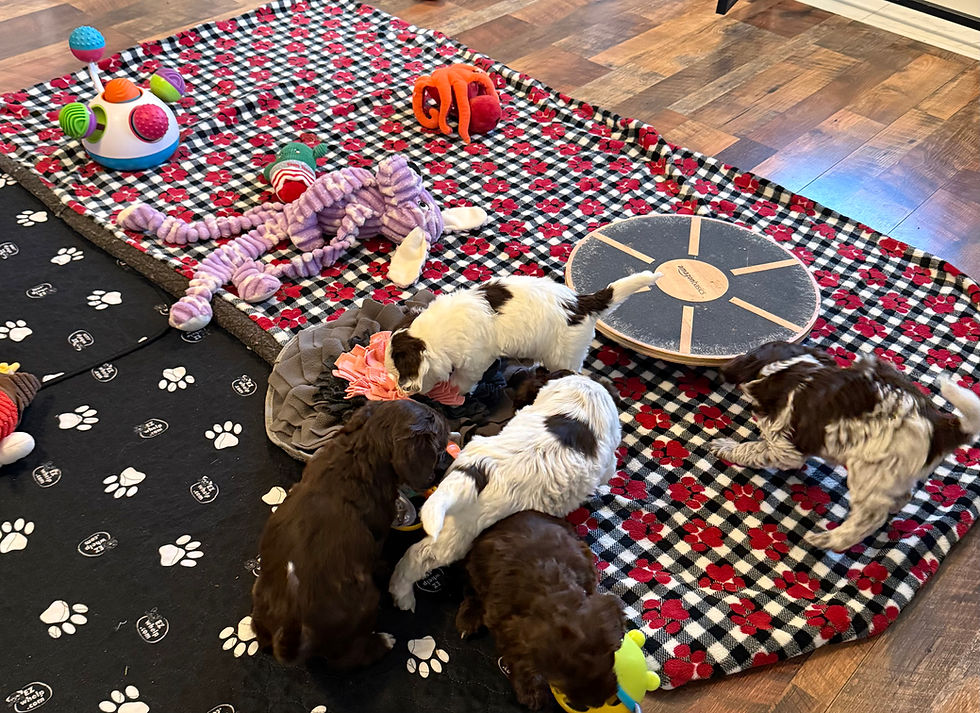
When thoughtfully bred and carefully matched, an Australian Labradoodle can become not just a therapy dog—but a life-changing companion.
And honestly, that’s what makes them so special.If you’ve spent any time researching “doodle” dogs, you’ve probably noticed how many options there are—Goldendoodles, Bernedoodles, Sheepadoodles, and more. At first glance, they can all look pretty similar: fluffy coats, expressive eyes, and that lovable, family-friendly vibe. But beneath the surface, not all doodles are created equal. One in particular—the Australian Labradoodle—stands apart in some meaningful ways.

About Moonlit Acres
Choosing where your puppy comes from matters—not just for your family, but for the long-term health and well-being of the breed itself. At Moonlit Acres, we prioritize health testing, temperament, and responsible placement, ensuring our dogs are raised in loving home environments rather than kennels. At Moonlit Acres, every dog is part of a family through our guardian program, receiving individualized care, socialization, and attention while contributing to a thoughtfully managed breeding program focused on sound structure and sweet dispositions.
If you are considering adding an Australian Labradoodle to your life—or are interested in becoming part of a guardian family or learning more about their stud services—now is the perfect time to connect with Moonlit Acres. Our commitment to raising well-socialized, healthy puppies with intention and care sets us apart.
Reach out today to learn more about available puppies, the guardian program, or upcoming opportunities, and take the first step toward welcoming an exceptional companion into your home.


Comments